Old Testament Reading for Palm Sunday Catholic
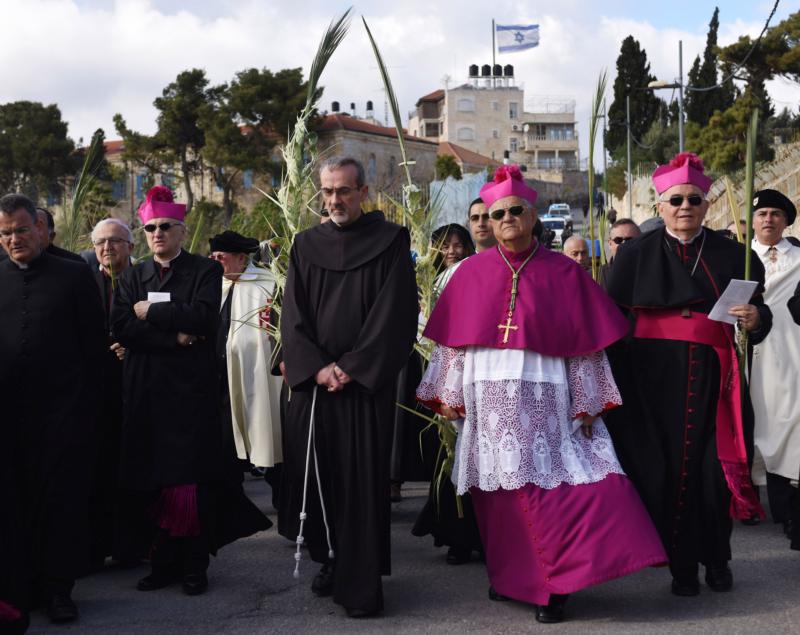
Now retired Latin Patriarch Fouad Twal of Jerusalem walks in the almanac Palm Sunday procession on the Mountain of Olives overlooking the Old City of Jerusalem March twenty, 2016. The life and ministry of Jesus Christ was the fulfillment of centuries of prophecy, and when the Gospel was spread around the world, this point got bang-up accent. (CNS photo/Debbie Hill)
Information technology is a common adage by at present that the Old Testament is fulfilled in the New Testament, and the New revealed in the Old. The life and ministry of Jesus Christ was the fulfillment of centuries of prophecy, and when the Gospel was spread around the world, this betoken got not bad emphasis.
Nosotros, as Catholics, see ourselves in continuity with the aboriginal Jewish people, and as a result we have a special involvement in understanding how the prophecies of the Sometime Testament came to fulfillment in Jesus.
This year on Palm Sunday, nosotros read the account from the Gospel of Matthew of the entrance of Jesus into Jerusalem. Scholars typically recognize Matthew's as the Gospel with the greatest focus on the fulfillment of Old Testament prophecy, and this scene is no exception.
In Matthew'southward recounting of the archway into Jerusalem, Matthew specifically draws attention to a number of Old Testament prophecies being fulfilled in Jesus.
In the starting time verse of Matthew'southward recounting of the archway into Jerusalem, we hear that Jesus and the disciples were in Bethpage. Bethpage is one of the last villages on the road from Jericho to Jerusalem, and is located on the Mount of Olives.
The hamlet is pregnant in the context of Quondam Testament prophecy, as Zechariah prophesied that this would be where God's kingship over the entire world would ultimately be revealed (Zec. 14:iv-ix). This is especially important to recall in light of the great kingship prophecies that would be fulfilled equally Jesus continued into the metropolis of Jerusalem.
At that place is 1 cursory passage, in particular, that contains some of the nearly profound symbolism and prophecy fulfillment in the whole of this scene: Jesus riding a filly on which no one has ever sat.
In the Old Testament, it is often specified that an animal meant for a sacred purpose must non have been put to any ordinary use earlier. This stipulation can exist found in Numbers nineteen:ii, Deuteronomy 21:3 and 1 Samuel 6:seven.
Pope Benedict XVI, in his marvelous book, "Jesus of Nazareth: Holy Week: From the Entrance into Jerusalem to the Resurrection," says that this may seem harmless to today'southward reader, "but for the Jewish contemporaries of Jesus information technology is total of mysterious allusions."
Even the fact that Jesus requested a way of send, by sending two disciples to larn the colt because "the master has demand of it," is Jesus challenge the correct of kings. This as well brings to mind Genesis 49:10-11, in which Judah is promised the scepter, the ruler's staff.
In this passage, it is said that Judah binds his donkey to the vine. "The tethered donkey, and so," says Pope Benedict, "indicates the one who is to come, 'to (whom) shall be the obedience of the peoples.'" Here once more, Jesus is claiming for himself the rights proper to kingship, which would not have been missed by his contemporary Jews.
Matthew explicitly quotes Zechariah 9:9: "Exult greatly, O daughter Zion! Shout for joy, O daughter Jerusalem! Behold: Your king is coming to yous, a simply savior is he, humble, and riding on a donkey, on a colt, the foal of a donkey" (see Mt 21:5). Jesus is displaying kingship, but he is the rex of peace, of simplicity, of humility.
"Jesus is indeed making a royal claim," Benedict writes. "He wants his path and his action to be understood in terms of Old Testament promises that are fulfilled in his person. The One-time Testament speaks of him — and vice versa: He acts and lives within the discussion of God, not according to projects and wishes of his ain."
The narrative tells of the crowd covering the ground with their cloaks and palm branches as Jesus passed them by. This gesture is another that is fraught with symbolism and meaning from the Sometime Testament.
The spreading of cloaks and branches is an image of enthronement in the line of Male monarch David, hearkening back to ii Kings 9:13 and i Maccabees 13:51: "The Jews entered the citadel with shouts of praise, the waving of palm branches, the playing of harps and cymbals and lyres, and the singing of hymns and canticles, because a groovy enemy of Israel had been crushed."
Equally Jesus entered Jerusalem, another neat enemy of State of israel — the greatest enemy — was about to exist crushed as well.
The people were overcome, shouting the words of Psalm 118, "which on their lips becomes a messianic annunciation," Pope Bridegroom writes. Shouts of "Hosanna!" make full the air.
Over the course of Jewish history, the connotations of "Hosanna" developed from a prayer of supplication to one of praise, "joyful praise of God at the moment of the processional entry, promise that the hour of the Messiah had arrived, and at the aforementioned time a prayer that the Davidic kingship and hence God's kingship over State of israel would be re-established."
Jesus has now entered the holy city of Jerusalem, and fabricated clear the divine claim to kingship. His hour has come, and with information technology, the hr of our salvation — the salvation which God promised his people of one-time.
***
Senz is a freelance author living in Oregon with his family.
Source: https://catholicphilly.com/2017/04/catholic-spirituality/palm-sunday-how-jesus-entry-into-jerusalem-fulfills-old-testament-prophecy/
0 Response to "Old Testament Reading for Palm Sunday Catholic"
Enviar um comentário